
We went to de-RSE 26 in Stuttgart - Here's what we brought back

Posters, talks, and three travel grants - that was JuRSE at de-RSE 26. In early March, 20 members of the Forschungszentrum Jülich headed to Stuttgart for the annual conference for research software engineers in Germany, featuring around 100 talks and workshops and 60 posters across five parallel tracks. It's the kind of event where the person presenting next to you might be a physicist, a software architect, or both. We go to stay sharp, to see what the community is working on, and to talk to people doing work adjacent to ours. But just as importantly, we go to strengthen the RSE community - at FZJ and across Germany.
This year FZJ brought a range of posters covering work from across the institute:
RSE of a Quantum Transport Code and its Effects
Software CaRD: Decentralised Software Metadata Curation
Embedded Artificial Neural Networks for Energy-Restricted Edge-Computing Applications
A Framework for Consistent Measurement Workflows across IC Development, Verification and Data Management
Sensor Scan Simulation for Automated Sensor Tuning of Gate-Defined Semiconductor Quantum Dots
JuRSE Community Manager Claire Wyatt also gave a talk titled "Exploring Diverse Community Building for Research Software", which looked at how different centres, institutions, and projects are approaching community building for research software - and for the people who create it.
Part of showing up for the community also meant helping others get there. This year JuRSE supported three participants from across Germany with travel grants.
Here's what the grant recipients had to say about their experience:
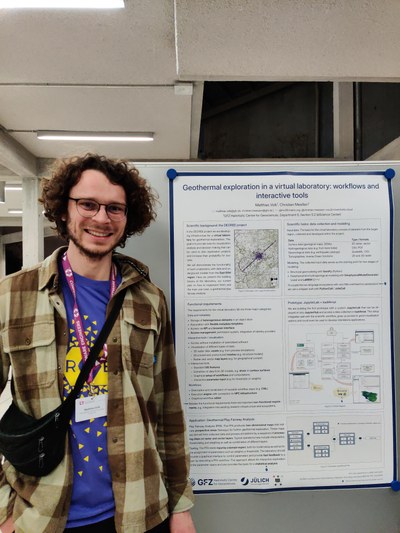
I really enjoyed the deRSE 26! I liked that there was a lot of room for discussion and exchange of ideas.
I was surprised by the wide spectrum of topics presented ranging from highly technical engineering challenges through metadata handling to community building efforts.
I learned a lot, met a lot of people and last but not least had lots of fun!
I really liked being part of the deRSE 26 and apreciated the variety of formats in particular posters and demo sessions, which were inspiring and offered scientific perspectives from different fields and communities.

I am very grateful for the travel grant that enabled my attendance of the deRSE 26 conference. As a research software engineer this conference provided me a platform for knowledge exchange and the opportunity to discuss research software with many people from different backgrounds.
A highlight of the event was presenting my poster at the 1st Research Software Day.
The RSE field is maturing fast, and de-RSE is one of the places where you can feel that momentum in real time. Curious about what else was on? Browse the full contribution list here.